The ultimate guide to multimodal data:
Applications, challenges, and technology

Introduction
We've created this guide as a handy reference about multimodal data. We will consider common use cases and explore the challenges of working with multimodal data. Finally, we will outline key considerations for evaluating technology or platforms when working with multimodal data. Please bookmark this page and share it with colleagues if you find it helpful, as we will make updates.
What is multimodal data?
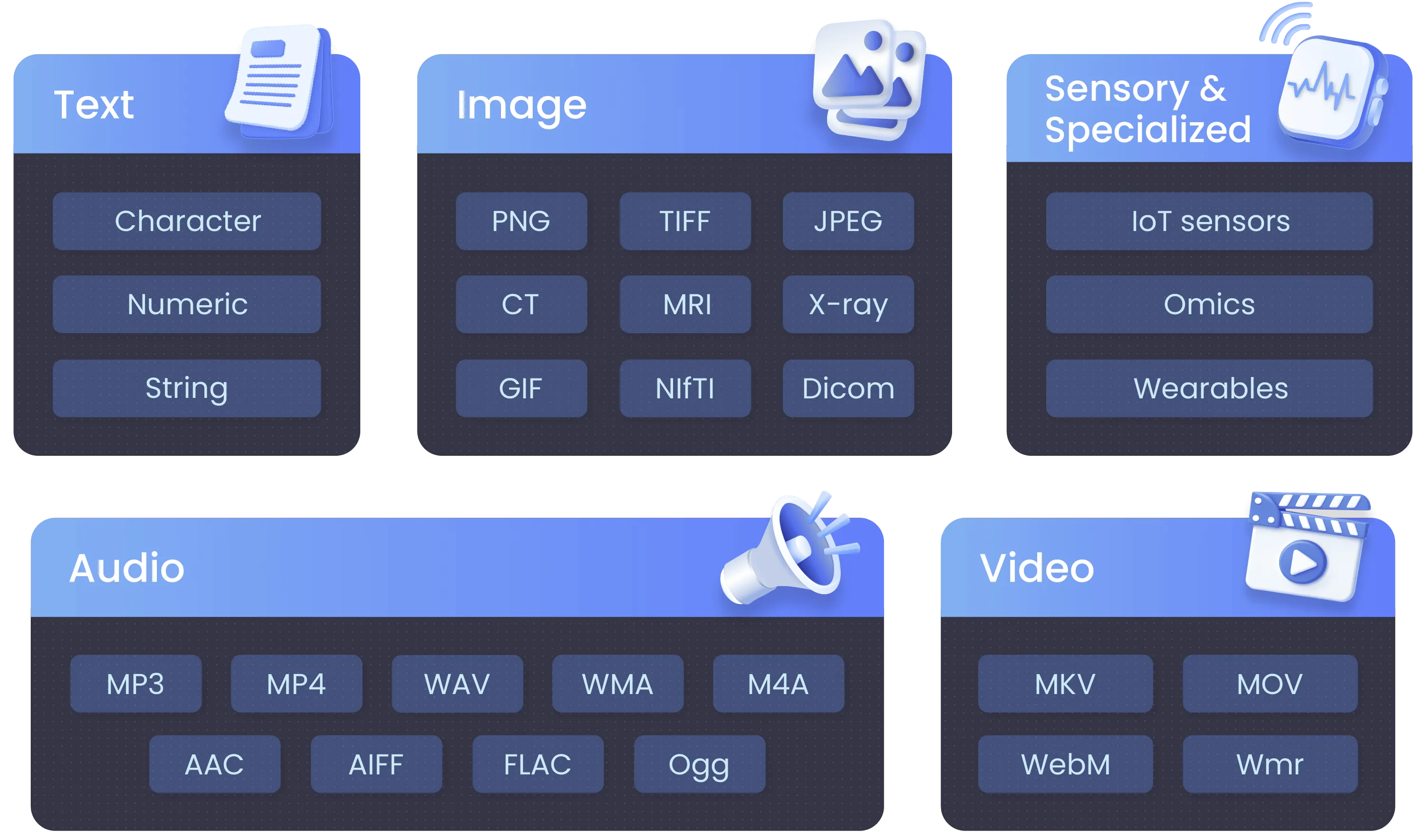
Multimodal data is information that exists across multiple different formats or modalities simultaneously, including text, audio, image, video, and sensory or specialized data. Unlike traditional unimodal data, which is restricted to a single type of information, multimodal data integrates two or more of these diverse forms to provide a comprehensive representation of entities, events, or phenomena.
From a technical perspective, multimodal data presents significant design challenges because each modality has its own structure, scale, and semantic properties. For example, text data is typically processed as sequences of tokens, images as pixel matrices, audio as waveforms, and time series as sequential numerical values, each requiring different storage formats, preprocessing techniques, and analytical approaches.
Here's what that looks like in the real world. A patient's comprehensive healthcare record can include a combination of data types, formats, and structures:
Structured data
Demographics, lab results, medication history
tabularTime-series data
Vital signs, continuous glucose monitoring
sequentialUnstructured text
Clinical notes, medical history
textImaging data
X-rays, MRIs, CT scans
volumetric image dataGenomic sequences
DNA/RNA data
specialized formatsEach modality captures different aspects of the patient's health status. When analyzed in isolation, these data types provide limited insights, but when properly integrated, they enable a holistic understanding that powers precision medicine initiatives, improves diagnostic accuracy, and optimizes treatment plans.
Of course, most real-world entities and processes are inherently multimodal. Customer interactions span digital clicks, voice calls, and in-person visits. Manufacturing processes generate sensor readings, quality inspection images, and maintenance logs. Financial transactions include structured data, document scans, and communication records.
However, few modern data platforms are designed specifically to handle these diverse data types in a unified system, addressing technical complexities while enabling more effective integration and analysis.
If you are in the life sciences and are already exploring multimodal data platforms, this buyer's guide could be a helpful resource.
Why are multimodal data important?
Multimodal data are important because most real-world phenomena produce data that can be captured across many modalities. These data can be recorded using many devices, such as cameras, sensors, and computed tomography (CT) scanners. For data scientists, AI developers, and others who work with data and technology, utilizing multiple types of data offers significant advantages in understanding real-world phenomena and building performant AI applications and systems. The more data you have to work with, the more accurate your resulting analysis and outcomes will be.
Consider a consumer's interaction with a superstore that sells a wide variety of merchandise. The retailer can offer the consumer a membership in a rewards program and assign them a number to enter before making purchases, allowing the retailer to gather data about the customer's preferred products. The retailer can gather video of that customer when they use a self-checkout machine in the store. If the customer interacts with a smartphone application that allows them to place orders online, they can collect and analyze data based on those interactions.
These are just a few of the many ways retailers can gather multimodal data. The retailer can use that data to offer customers products, pricing, and other incentives that appeal to them, thereby enhancing their experience and fostering brand loyalty. With each new type of data gathered, the retailer establishes a more complete view of the customer and can tailor their experience with the brand.
Strategic business value and technical advantages of multimodal data
Here are a few key ways that organizations can leverage multimodal data strategies for demonstrated, strategic business value:
Competitive differentiation
Create barriers to competition through insights unavailable from conventional single-modality approaches. Multimodal data can fuel innovative breakthroughs and new solutions to challenging problems by revealing hidden value from data.
A more complete decision context
Multimodal data provides executives and decision-makers with comprehensive information that incorporates multiple perspectives. For example, a customer intelligence platform that integrates purchase history, service interactions, and social sentiment can provide a 360-degree view that enables more effective engagement strategies.
Innovation acceleration
The integration of diverse data types often reveals previously invisible patterns and relationships, creating opportunities for product innovation, process optimization, and the development of new business models. Cancer researchers are using multimodal data to perform virtual biopsies, avoiding the need for invasive procedures and enhancing the accuracy of outcome predictions.
Enhanced risk management
Multiple complementary data sources provide earlier and more reliable risk signals across domains from cybersecurity to financial compliance. Financial institutions have implemented multimodal data systems that combine transaction patterns with behavioral biometrics for more accurate fraud detection.
Technical advantages of multimodal data for AI
For people who develop and monitor AI systems, working with multimodal data offers significant technical advantages. The clinical picture is covered separately in our guide to multimodal AI in healthcare.
AI model performance
Models trained on diverse, complementary data types consistently outperform unimodal alternatives. A study on multimodal deep learning for solar radiation forecasting found a 233% improvement in performance when applying a multimodal data approach compared to using unimodal data.
Redundancy
Multimodal systems maintain performance even when one data source is compromised, damaged, or missing. This redundancy is crucial for applications that require high reliability, such as autonomous systems or medical diagnostics. Duke researchers found multimodal data redundancy could protect autonomous systems against an attack strategy that can fool vehicle sensors into perceiving nearby objects are closer (or further) than they appear.
Transfer learning opportunities
Knowledge gained from one modality can be transferred to improve performance in another, reducing the data requirements for new applications or domains.
Reduced model overfitting
Models trained on multiple data types are less likely to overfit to artifacts in any single modality, resulting in better generalization to new data. Technical implementations can leverage this property to create more deployable models with consistent performance across diverse operational conditions.
Multimodal data types and characteristics
The key characteristics of multimodal data create both challenges and opportunities for data practitioners and organizational leaders. Understanding these properties is essential for effective system design and strategic planning.
Heterogeneity
Multimodal data encompasses fundamentally different information types with varying structures, formats, dimensions, and scales. This heterogeneity creates significant technical challenges for storage, processing, and analysis. For example, integrating textual medical records (unstructured, symbolic) with MRI scans (dense grids of pixel intensities) requires specialized approaches that traditional homogeneous data systems cannot support.
Complementarity
Different modalities capture complementary aspects of the same underlying phenomenon, providing a more complete picture when properly combined. For example, in autonomous vehicles, cameras capture color and texture information, lidar measures precise distances, and radar detects velocity. Each of these devices complements the limitations of the others. This complementarity is the primary source of the performance advantages in multimodal systems.
Correlation and alignment challenges
While meaningful relationships exist between different modalities, establishing these correspondences presents significant technical challenges. Temporal alignment (synchronizing data collected at different frequencies), spatial registration (mapping between different coordinate systems), and semantic alignment (connecting concepts across modalities) all require sophisticated techniques. For example, in manufacturing settings, aligning high-frequency sensor data with lower-frequency quality inspection results often requires specialized pre-processing and alignment algorithms.
Variable dimensionality
Different data modalities have inherently different dimensional structures. Text may be one-dimensional (sequences), images two-dimensional, video three-dimensional (including time), and scientific data can be multi-dimensional tensors. This dimensional diversity impacts storage architecture, indexing approaches, and computational requirements.
Quality variations
Quality, accuracy, and reliability typically vary across modalities, creating challenges for integration. In security systems that combine video surveillance with audio monitoring, visual data may be compromised in low-light conditions, while audio remains clear. This requires intelligent fusion approaches that dynamically weight modalities based on reliability.
Storage and computational intensity
Multimodal datasets often require substantially more storage and processing resources than unimodal alternatives. High-resolution medical imaging, genomic sequencing, or video analysis can demand terabytes to petabytes of storage and specialized computational architectures for efficient processing.
Domain-specific semantics
Each modality often has its own domain-specific meaning and interpretative frameworks. For example, in healthcare, genomic data follow biological semantics, while clinical notes utilize medical terminology, and imaging data require radiological interpretation, necessitating domain knowledge across multiple specialties.
These characteristics have profound implications for data architecture and the selection of technology. Some platforms are designed specifically to address these challenges through universal data models that can represent diverse modalities while maintaining performance, scalability, and analytical flexibility.
Architectural considerations of multimodal data
When a team is working with more than two types of data, it's likely they will need to work with more than one tech stack or set of platforms and tools where data are collected, stored, and accessed. For technical teams, each multimodal data type requires specific architectural considerations, including:
Storage strategy
Different modalities have vastly different storage requirements. Text is relatively compact, while high-resolution images, video, or genomic data can be extremely storage-intensive.
Processing pipelines
Each modality typically requires specialized preprocessing techniques to be applied before integration.
Integration approach
The method of combining modalities (early, late, or hybrid fusion) has a significant impact on system design and performance.
Query optimization
Efficient querying across heterogeneous data types requires specialized indexing and query planning.
For executives, understanding these types helps prioritize investments and set realistic expectations for multimodal data initiatives.
Where the data is stored is a decision in its own right. Our guide to multimodal databases covers how they work, what the options are, and how to choose one for a given set of requirements.
Tile.ai makes diverse data types AI-ready wherever they already live, addressing these technical complexities without a migration. Request access to see it on your own data.
Applications of multimodal data
Multimodal data encompasses various combinations of different data types, each presenting unique technical challenges and business opportunities. Understanding these types enables organizations to plan effective data architectures and analytical approaches.
| Text and image | |
| Description | Combines textual data with visual information. Requires bridging natural language processing (NLP) and computer vision techniques. |
| Technical challenges | Cross-modal alignment and representation learning. |
| Storage requirements | Moderate to high, depending on image resolution |
| Business applications |
|
| Audio and visual | |
| Description | Merges acoustic data with visual information. Demands synchronized processing across time dimensions. |
| Technical challenges | Temporal alignment and handling different sampling rates. |
| Storage requirements | High, especially for high-definition video |
| Business applications |
|
| Time series and categorical | |
| Description | Pairs sequential numerical measurements with discrete classifications. |
| Technical challenges | Handling different temporal granularities and integrating continuous and discrete data types. |
| Storage requirements | Variable, but typically moderate |
| Business applications |
|
| Multiomics | |
| Description | Integrates different biological data types in life sciences. |
| Technical challenges | High dimensionality and complex biological relationships. |
| Storage requirements | Extremely high, often at petabyte scale |
| Business applications |
|
| Sensor fusion | |
| Description | Integrates data from multiple physical sensors. |
| Technical challenges | Real-time processing requirements and varying reliability across sensors. |
| Storage requirements | High, especially for continuous monitoring |
| Business applications |
|
| Spatiotemporal | |
| Description | Combines location information with time-based data. |
| Technical challenges | Specialized indexing for efficient queries across both dimensions. |
| Storage requirements | Moderate to high, depending on resolution |
| Business applications |
|
Challenges of working with multimodal data
Working with multimodal data presents significant challenges that organizations must address through both technical solutions and organizational strategies. Understanding these challenges enables technical teams to plan effective implementations, while allowing executives to set realistic expectations and allocate appropriate resources.
Technical challenges and examples
Data integration complexity
Combining fundamentally different data types with varying structures, formats, dimensions, and scales presents substantial technical difficulties.
For example, a healthcare organization with a precision medicine mandate may face this challenge when attempting to integrate genomic data (massive, specialized formats) with clinical records (structured and unstructured) and medical imaging (multi-dimensional). Implementation could require:
- Custom ETL pipelines for each data modality
- Specialized storage architectures optimized for each data type
- Common metadata framework linking diverse information
- Ontology mapping to standardize terminology across domains
Storage and computational requirements
Multimodal data, particularly when involving high-resolution imagery, video, or scientific data, demands enormous storage capacity and computational resources.
For example, a typical intelligent vehicle can generate 5–20TB of sensor data daily, requiring:
- Distributed storage architecture
- Tiered storage strategy (hot/warm/cold data)
- Parallel computing infrastructure
- Edge processing for real-time components
- Specialized hardware for different processing needs (GPUs, FPGAs)
Quality and alignment inconsistencies
Data quality often varies significantly across modalities, with different noise profiles, missing data patterns, and reliability characteristics. Temporal and spatial alignment between modalities presents additional challenges.
For example, a manufacturing company implementing multimodal quality control could face misalignment between:
- High-frequency sensor readings (millisecond intervals)
- Lower-frequency quality inspection results (minutes)
- Maintenance logs (daily/weekly records)
Addressing these inconsistencies required sophisticated synchronization algorithms and data quality assessment frameworks.
Specialized expertise requirements
Effectively working with multimodal data requires expertise across multiple domains and technologies. Organizations often struggle to find talent with the breadth of knowledge needed to work across text analytics, image processing, time-series analysis, and other specialized techniques.
Organizational challenges
Data silos and ownership issues
Different modalities often originate in different departments with separate owners, technologies, and governance processes. Breaking down these silos requires organizational change management as much as technical integration.
ROI justification complexity
Multimodal data initiatives typically require significant upfront investment before delivering business value. Executives often struggle to develop compelling business cases with traditional ROI frameworks.
Governance and compliance complexity
Different data types may be subject to varying privacy regulations and security requirements. For example, a financial services firm implementing multimodal KYC (know your customer) could face distinct regulatory requirements for:
- Biometric data (requiring explicit consent)
- Transaction information (subject to financial regulations)
- Document images (with personally identifiable information)
- Communication records (with varying retention requirements)
Scaling and productionization
Moving multimodal systems from proof-of-concept to production introduces new challenges in operational reliability, monitoring, and maintenance. Organizations often underestimate the complexity of operationalizing multimodal data pipelines.
Implementation approaches
Organizations can address these challenges through:
- Phased implementation: Beginning with integration of two complementary modalities before expanding to more complex combinations
- Unified data platforms: Adopting technologies like Tile.ai that are specifically designed to handle diverse data types within a single system, reducing integration complexity
- Composable architecture: Building modular data pipelines that can be reconfigured for different modality combinations
- Cross-functional teams: Creating integrated teams that combine domain expertise with data engineering and data science capabilities
- Governance frameworks: Developing comprehensive data governance approaches that address the specific requirements of multimodal data
For executives, understanding these challenges helps set realistic timelines and resource allocations. For technical teams, anticipating these obstacles enables more effective architecture and implementation planning.
Multimodal data applications
in the life sciences
Implementation and technical architecture
Life sciences organizations are at the forefront of multimodal data integration, combining diverse biological and clinical data types to accelerate research, improve patient outcomes, and develop breakthrough therapies. This sector demonstrates both the transformative potential and technical challenges of effectively managed multimodal data.
Technical implementation
Modern life sciences research generates unprecedented volumes and varieties of data. A typical multi-omics pipeline might include:
- Genomics: DNA sequencing data (FASTQ/BAM/VCF formats, terabytes per sample)
- Transcriptomics: RNA expression measurements (matrices, arrays)
- Proteomics: Protein abundance/modification data (MS data)
- Metabolomics: Small molecule profiles (chromatography data)
- Imaging: Microscopy, radiological imaging (DICOM, proprietary formats)
- Clinical: Electronic health records, trial data (structured and unstructured)
The technical architecture for managing this diverse data typically includes several layers, with each providing key capabilities for multimodal data:
Storage
Specialized repositories for each data type with appropriate compression and access patterns
Integration
Data harmonization services with standardized metadata models
Analysis
Modality-specific and cross-modal analytical pipelines
Governance
Controls for sensitive patient data and intellectual property
Implementation challenges include the extreme scale of certain modalities (for example, genomic sequencing can generate terabytes of data per sample), standardization across proprietary instruments and formats, and the need for specialized expertise spanning both data science and biological domains.
Scientific applications
The integration of multimodal data has transformed numerous life sciences disciplines:
Genomic medicine
Studies such as the Cancer Genome Atlas (TCGA) have analyzed over 20,000 primary cancer samples across 33 cancer types using multiple genomic platforms, leading to the identification of novel molecular subtypes and potential therapeutic targets. This work required sophisticated data management approaches to handle petabytes of multimodal data generated by diverse sequencing and analytical platforms.
Drug discovery
Pharmaceutical companies combine chemical structure information, target binding affinity data, gene expression responses, and clinical outcomes to identify promising compounds. Harvard University research published in March 2025 demonstrated that a multimodal AI model combining structural, pathway, cell viability, and transcriptomic data improved the prediction accuracy of clinical outcomes of drug combinations by up to 22.5% compared to single-modality approaches. The model predicted drug combination effects across 953 clinical outcomes and 21,842 compounds, including combinations of approved drugs and novel compounds in development.
Precision medicine
Initiatives like the National Institutes for Health's (NIH) All of Us Research Program collect genomic, electronic health record, environmental, and lifestyle data from diverse participants to build comprehensive multimodal datasets for advancing personalized health interventions. These programs generate petabyte-scale heterogeneous datasets that require specialized management approaches.
Single-cell biology
Recent advances in single-cell technologies generate unprecedented views of cellular heterogeneity by simultaneously measuring multiple molecular features of individual cells. The Human Cell Atlas project, for example, combines single-cell RNA sequencing, ATAC-seq, spatial transcriptomics, and imaging data to create comprehensive cellular maps, requiring sophisticated data integration techniques.
Public resources like these are where most multimodal projects begin. Our list of 15 multimodal datasets to know in 2026 covers TCGA, UK Biobank and the Human Cell Atlas alongside imaging, video and vision-language collections.
Tile.ai's approach: multimodal data and the life sciences
Tile.ai is the Enterprise AI Data Substrate — a governed layer that sits alongside the data and applications you already use, activating them in place for your AI. It does not replace existing data infrastructure. It sits between the people and agents that need the data and the systems it already lives in, and every data asset becomes a Tile: a single unit an agent can call in place, packaged with everything it needs to use that data safely. Multimodal data becomes discoverable, accessible and governed without ingest, migration or copies.
In the life sciences, that plays out across four areas:
One namespace across every source
Sequencing data in object storage, expression tables in a warehouse, imaging in a separate archive and protocol documents in a wiki all land in one searchable namespace, with nothing hidden and nothing left behind. Each Tile carries the operations its own format needs, so a variant file is queried by genomic region and a whole-slide image is opened at magnification, without either being converted first.
Performance at scale
One interface over every source, any format queried in place, no pipelines and no copies. Queries execute against the source at scale without moving the data: an indexed lookup on a variant file fetches only the region requested rather than the whole file, and a gigapixel pathology slide streams from its resolution pyramid, so the slide never leaves the bucket it is stored in.
Collaboration infrastructure
Access is identity-bound, with full audit and reproducible results enforced on every source. Every call runs as the user rather than as a shared service account, so every access is logged, attributed and revocable — the audit trail multi-center research requires, under the organization's own security policies, on-premises or in the cloud.
Future-proof architecture
The life sciences field continuously develops new experimental technologies and data types. The Tile is the same unit for every one of them, and Tile.ai builds custom Tiles for any remaining source — internal APIs, legacy databases, proprietary formats — governed and audited like everything else.
Frequently asked questions
What is multimodal data?
Can data be multimodal?
How do you deal with multimodal data?
Can multimodal data improve the accuracy of AI models?
Yes. Models that incorporate complementary data types outperform single-modality alternatives across a range of applications. Drug discovery is one measured example: the Harvard University research cited above found a multimodal model improved prediction accuracy of clinical outcomes of drug combinations by up to 22.5%, across 953 clinical outcomes and 21,842 compounds.
These improvements occur because different modalities capture complementary aspects of the underlying phenomenon, provide redundancy that enhances robustness, and enable cross-validation between sources.