Ask anything across all your data.
Every data asset becomes a Tile — a single unit your agents can call in place, packaged with everything they need to use it safely.
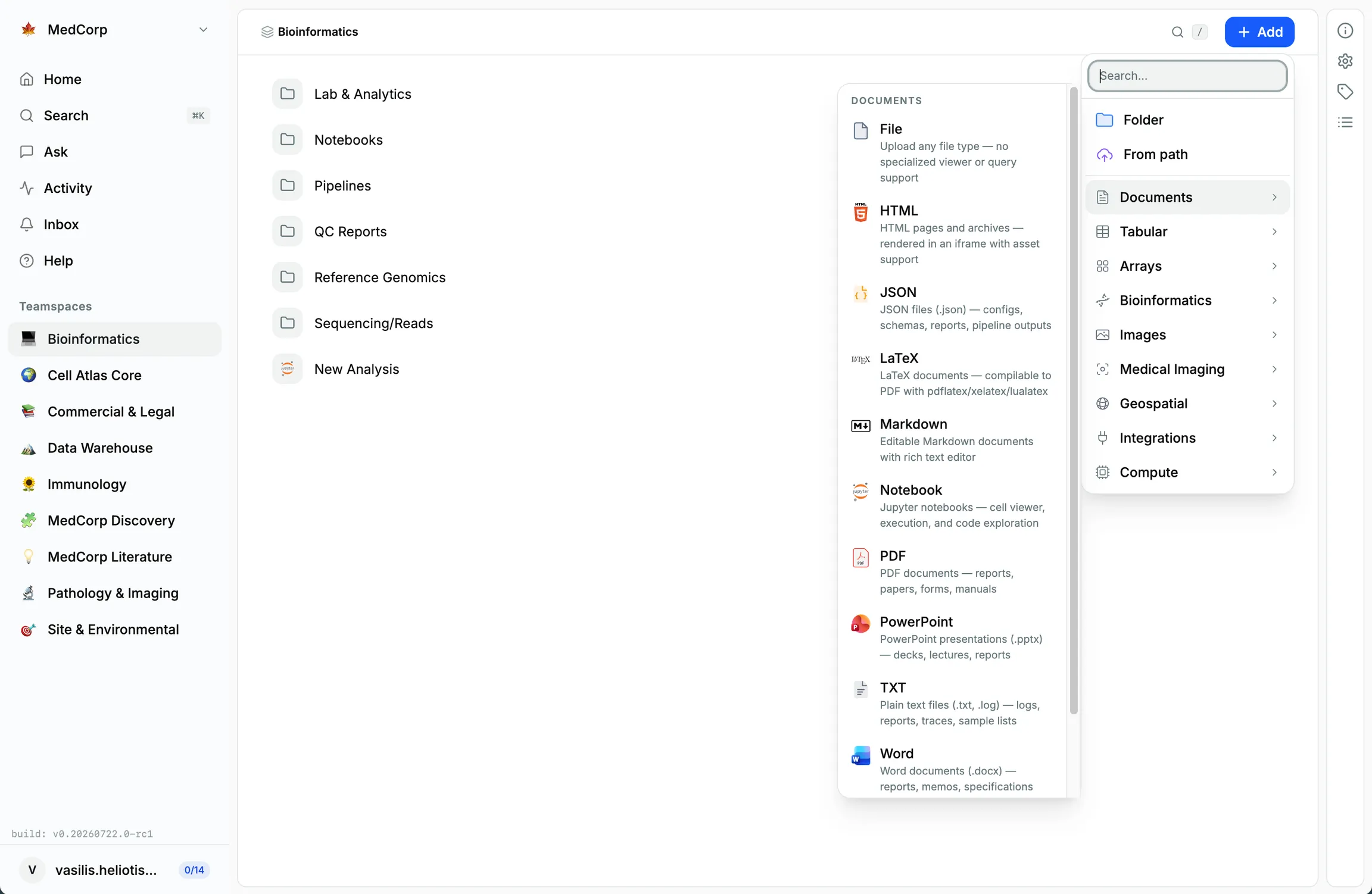
From data silos to answers synthesized from every source.
Point an agent across all your governed Tiles at once — each queried in place with its own typed tools, as you — and it composes answers a single source never could. And because every call runs as the user, not a shared account, every step is attributable.
 The Enterprise AI Data Substrate
- Reference literature paper

 Gemini · 3.6 Flash
 - Variant calls (Genomics)

 Claude · Opus 5
 - Single-cell expression

 GPT · 5.6 Luna
 - Tissue images (Pathology)
 Claude · Sonnet 5
Inherited compliance
& security policies
Overlap across variants, single-cell expression, and pathology imaging. 240 samples carry the mutation, the expression signature, and matching pathology — one cohort, three data types.
What is a Tile
A Tile is an agent-ready handle over an existing asset — a file in your bucket, a table in your warehouse, a record in a SaaS service. The asset never moves. Each Tile brings together four important components: the data itself and a secure means to access it, the context to find and understand it, the tools to query it in its native language, and the runtime to execute queries against it.
Source
Access and identity. Tile.ai reads the asset where it already lives — a file in storage, a warehouse table, a SaaS record — in place, as the user's own identity. Nothing is copied or migrated, and access is always gated by the permissions at the source.
From one Tile to a substrate
One Tile makes a single source usable. Create Tiles across your files, tables, and services, and together they form one surface your teams and agents work through — the Enterprise AI Data Substrate.
One interface, every source
Every source becomes a Tile, reachable through the same interface, whatever the format or system it lives in — nothing sits outside it, and nothing moves to get in.
Governed in place
Whether a scientist queries a Tile or an agent acts on it, identity, access, and policy are enforced at runtime — with no second permissions system.
Discoverable
Search all your sources in plain language and get the right Tiles back.
Queryable
Ask a Tile a question or pull structured fields back — the same call for people and agents.
Shareable
Grant access to a Tile, not a copy of the data or credentials to the system beneath it.


Traceable
Trace any answer back to its data and reproduce it — every access and query is recorded.
A governed layer alongside the infrastructure you already run.
Tile.ai doesn't replace your data infrastructure — it sits between the people and agents who need your data and the systems it already lives in. Each source becomes a Tile, with the tools and runtime to query it in place, reachable through the interfaces your teams already use.
 The Enterprise AI Data Substrate
The source data never movesEverything is a TileInherited security policies











Activate any data, whatever the format.
Genomics, imaging, documents, tables, and compute assets — Tile.ai has a built-in Tile for each, so your existing data is discoverable and queryable right out of the box — ready for your agents. Pick a category to explore the formats it covers.



VCF
variant calls · SNPs & indelsDon't see your data source? We'll Tile it.
We partner with your team to build a custom Tile for any source — internal APIs, legacy databases, proprietary formats — governed and audited like everything else.
- Specialized files out-of-the-box
- Service Tiles for any data service
- Custom Tiles co-built with your team
Activate your data today.
Point us to a data source and a service, and we'll have your agents calling Tiles in an afternoon.