
Introducing the Enterprise AI Data Substrate

Enterprise AI has a data problem, and it’s not the one most teams are solving for. The models are extraordinary and getting better every quarter. The agents are capable and getting more capable. And still, despite $30–40 billion of enterprise investment in GenAI, 95% of organizations are getting zero return.¹ The gap is one layer down, in the data underneath them. Agents need a data layer that connects data sources across silos, providing the context they need to answer the organization’s most difficult questions — and in most enterprises, that layer doesn’t exist: data is scattered across buckets, warehouses, SaaS, and file shares, ungoverned and shaped for human eyes, not agent calls.
Tile.ai is that layer — the single layer that activates all your enterprise data, wherever it lives. We call it the Enterprise AI Data Substrate.
The name is new. The work behind it goes back nine years. TileDB began as an open-source universal array storage engine for complex data, and that engine still powers scientific workloads in production today — it continues under its own name. What changed was what customers asked us for. Over the past several years, they stopped asking about storing or querying complex data faster. They asked us to make all of their enterprise data ready for AI — without moving it or losing control of it.
Tile.ai is our answer to that shift.
Three blockers. Every enterprise.
The problem is concrete, and it’s the same three blockers almost everywhere you look.
Can’t find
Data is scattered across diverse, specialized systems, with no way to search across all of it in context — an agent can’t even locate what it needs.
Can’t use
Even after you’ve located an asset, each format needs its own libraries and compute to open — so working with a 100 GB genomic file and a multi-terabyte warehouse table in a single workflow is a project in itself.
Can’t trust
And even when the data can be read, there’s no identity-aware way to govern who, or which agent, is allowed to touch it.
None of these is a model problem. Each blocker sits in the data layer beneath it — and removing all three is what the Enterprise AI Data Substrate is built for.
What we mean by “substrate”
In the lab, a substrate is the layer everything else grows on. In the enterprise, it’s a thin, governed layer that sits between your existing data infrastructure and your AI — activating them in place. It runs alongside what you already have — no migration, no new silo, no rip-and-replace.
Let’s start with what the substrate isn’t:
- It’s not a catalog. A catalog describes your data, then stops. The substrate makes it callable — discoverable, queryable, and governed.
- It’s not a lake or a warehouse. Those are destinations you move data into. The substrate leaves your data exactly where it lives and activates it in place.
- It’s not another silo. It doesn’t add one more system of record. It lets the ones you already have work as one.
Warehouses and lakehouses store data and run queries. Catalogs describe it. The substrate is where agents find your data and act on it in context with the right tools. Tile.ai is the interface to AI — the one governed surface every agent and team calls through, sitting between your data estate and the models that need it, not replacing the systems that hold it.
The substrate is built on a core primitive: the Tile. A Tile is a smart wrapper around a piece of your data. Think of it as an interpreter standing next to the data: it speaks the data’s language and understands the context around it — what the data is and how to work with it — so your AI knows what to do with it. It also controls who’s allowed to use it and logs everything, all while the data stays exactly where it lives. Your AI stops facing a locked filing cabinet and starts working with someone who knows what’s inside.
A Tile is a governed, agent-ready handle over an existing asset — a file in your bucket, a table in your warehouse, a record in a SaaS service, a compute job, a specialized scientific format like BAM, VCF, or DICOM. The asset never moves. But once it’s a Tile, it carries everything an agent needs to use it: rich per-type context, the tools to query it in its native language, the runtime to execute them, identity-aware access, and an audit record on every call.
A Tile declares how to reach and operate on a source; the platform makes every Tile discoverable, governed, and reproducible. The full anatomy — what a Tile defines and what the platform wraps around it — gets its own deep dive in Tile: The building block of enterprise AI.
Why the AI era needs a new layer
The instinct, when you want agents to use enterprise data, is to point them at the raw sources: stand up an MCP server (or a REST API) for each system and let the agents call it. You can make this work for one source, or even a handful. The cost shows up when it has to hold across the whole estate, forever — because what you’re actually signing up to build and operate is three separate things, per source, indefinitely:
An integration to build, secure, and maintain — for every source, and every client that consumes it
MCP helps: one well-built server can serve many agent clients over the same protocol. What the protocol doesn’t standardize is everything that makes a server trustworthy — identity, policy, rate limits, audit. Each server reimplements those by hand, then has to be security-reviewed, kept alive as the upstream API drifts, and have credentials provisioned and rotated for every client allowed to reach it. One source is a project. Forty sources is a permanent team.
A runtime that can reach and read each source
Calling a service is the easy part; operating on its data is not. Variants need htslib, imaging needs pydicom, columnar files need DuckDB — specialized libraries with native dependencies, version constraints, and security patches of their own. And an answer you can trust has to be reproducible, which means pinned versions in a controlled, scalable runtime — not whatever happened to be on a developer’s machine. Every team that wants the data rebuilds all of this and re-secures it.
A single view of who did what, in one session
Every source keeps its own log — your cloud’s audit trail, your warehouse’s query history — but they’re disconnected and source-scoped. None can tell you that this user’s agent, in one session, read version 3 of a file, joined it against a warehouse table, and consulted a SaaS record. And the moment a call runs through a service account, even the per-source log records the robot, not the person. A session-level view spanning every source is something no source can emit; it has to sit above them.
None of these is impossible to build. An enterprise that builds all three will have built a substrate — one governed interface, one versioned runtime, one session-level record — except assembled ad hoc, per source, and maintained forever.
Tile.ai is that substrate, built once and uniformly: every source is reached through one governed interface, served by one versioned runtime, and captured in one session-level chain — whether the data is a genome or a general-ledger table. A question that used to take a week of manual stitching comes back sourced and reproducible.
Your data, finally ready for AI
Each of the blockers we mentioned above maps to a pillar of the substrate: Discoverable, Accessible, and Governed. Here’s what each does in practice.
Discoverable
Register any file or service, and it’s findable the moment it lands — by your teams and your agents, always within the access the source already grants. Every Tile carries context tuned to what it is: provenance for scientific files, schemas and sample queries for tables, semantic summaries for SaaS pages. Nothing gets lost in a rename; nothing hides in a bucket.
Accessible
Every Tile speaks its source’s native language and answers through whatever your team already uses — code, notebooks, a filesystem mount, or MCP for agents. No new tool to learn, no export step: the same primitive, queried the same way, whether it wraps a genome or a spreadsheet.
Governed
Every read runs as the person behind it — federated through the identity provider you already run — so the source’s own permissions are always the floor: Tile.ai never grants what the source denies. Every call lands in one audit chain, and every answer can be pinned to the exact versions it consulted, so a result produced today can be reproduced a year from now. An answer you can’t reproduce is an answer you can’t defend — to a regulator, an auditor, or a reviewer.
For scientific teams, these three will look familiar: they’re the FAIR principles, built in.
The same governance also makes sharing across the org line safe. Instead of secure FTP, drop-zone buckets, or shipping drives — each one a copy you’ve lost control of — you give a partner scoped access to the exact Tiles you choose, directly from where the data lives. Partners and collaborators authenticate through their own SSO, every read shows up in both sides’ audit logs, and access revokes in one click. Nothing is ever copied out. For pharma and diagnostics teams sharing results across organizations, this replaces an entire fragile workflow.
What you’ll never have to replace
The concept and implementation of Tile are the core differentiators of Tile.ai. A Tile — not a copy of the data, not a catalog entry — is the unit that agents call for downstream workflows. The substrate sits alongside everything you already run.
- It does not replace your warehouse or lake. They stay authoritative for what they hold; the substrate surfaces their tables as Tiles and pushes queries down to them.
- It does not replace your identity provider. Your IdP and directories remain the source of truth; the substrate federates against them.
- It does not replace your storage. Your buckets keep the bytes; the substrate activates them in place.
- It does not replace your models — or tie you to one. Models are interchangeable; your data is the advantage no vendor can hand you. The substrate is the bridge between the two: any model can work on your data while it stays logged, governed, and entirely yours.
The Tile.ai substrate adds the layer that none of those systems provide on their own: a unified, governed, agent-ready surface across all of them.
Four steps to deploy, none of them a migration
You’ll do it with our team, and it deploys as a single-tenant system in your own cloud account — the substrate sits next to your data rather than pulling it out.
1. Install
We work with your infrastructure team to install the platform using automated deployment of the entire system into your cloud account within one hour.
2. Set up
Admins connect your identity provider to federate access and configure your account’s default cloud storage and AI tooling. Users can then sign in with SSO so Tile.ai can apply the company’s existing access policies from source.
3. Organize
Create Tiles over your existing files and services — no migration, no copies; the bytes stay in your buckets, warehouses, and SaaS. Arrange them into workspaces, teamspaces, and folders that control who sees what. All access is identity-aware, audit-tracked, and revocable in one click.
4. Access
Query every Tile through the interfaces your team already uses — leveraging Tile.ai’s APIs and MCP — or spin up a notebook and mount your workspace as a local filesystem. Every read runs as the user’s federated identity, with source-side controls as the floor and a full audit chain on every call.
Your data never moves. Deploys in a day. Compliance-ready — every AI query logged, attributed, reproducible.
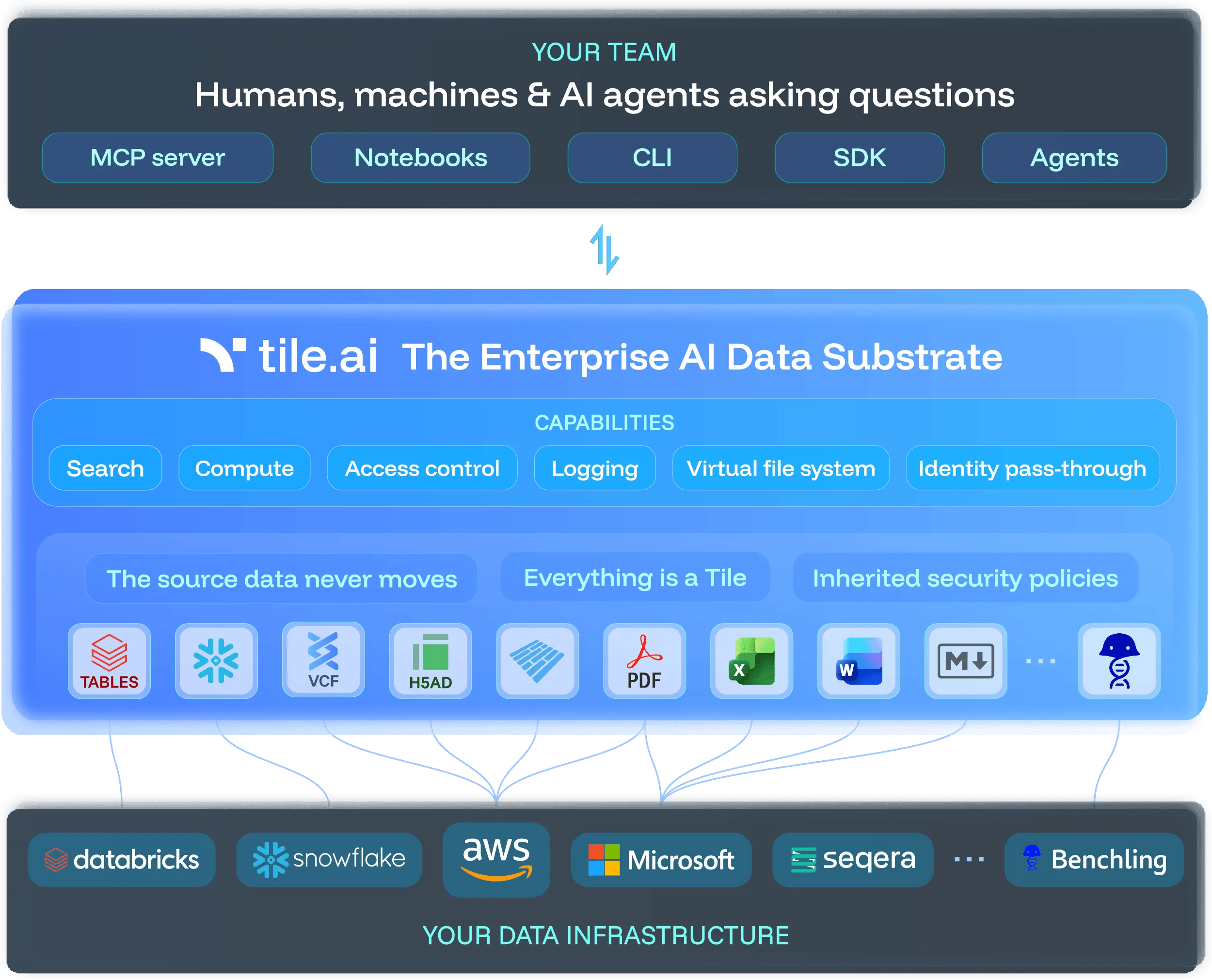
The product page goes deeper on the architecture and the Tile types we support today, and is the fastest way to see the substrate in action.
Where this is going
Every enterprise that puts agents to work on its data will end up with a substrate — because the alternative is building one by hand, source by source, forever. The only question is whether it will be assembled ad hoc or built once and for good, underneath everything.
As models get cheaper and more capable every quarter, the value of AI-ready data will compound — as will the opportunity cost of data that isn’t. Your competitors will reach the same models you do — the real edge is in the data you can safely and reproducibly put in front of AI, and that’s what a substrate delivers.
Your best data doesn’t have to sit dark while your AI ambitions wait on it. The questions that once meant weeks of stitching become a single query — answered and traceable. Activate your data where it lives.
¹ MIT (Project NANDA / Media Lab), The GenAI Divide: State of AI in Business 2025 https://mlq.ai/media/quarterly_decks/v0.1_State_of_AI_in_Business_2025_Report.pdf